If you’re starting creatine supplementation, you’ve probably asked yourself: How much creatine should I actually take?
The truth is, there’s no one-size-fits-all answer. Your optimal dosage depends on your body weight, gender, training goals, and whether you want faster results or a simpler approach.
This guide breaks down the science and gives you a personalized dosage recommendation using our free creatine dosage calculator.
Quick Answer: What’s the Correct Creatine Dosage?
For Most People:
- Loading phase: 20-25g per day (split into 4-5 doses) for 5-7 days
- Maintenance phase: 3-5g per day ongoing
But your specific dosage depends on:
- Body weight (heavier = higher dosage)
- Gender (women typically absorb differently)
- Training goal (strength vs muscle growth)
- Your preferred timeline (faster loading vs gradual steady-state)
The calculator below personalizes this for you based on YOUR metrics.
💪 Creatine Dosage Calculator
Find your optimal daily creatine dosage
- Kidney Disease: Pre-existing kidney disease or kidney problems
- Liver Issues: Liver disease or hepatic dysfunction
- Diabetes: Consult endocrinologist first – needs blood sugar monitoring
- High Blood Pressure: Uncontrolled hypertension (consult cardiologist)
- Medications: Taking drugs affecting kidney function
- Pregnancy/Nursing: Pregnant or breastfeeding women
- Age: Children under 13 years old
- Autoimmune: Anyone with autoimmune conditions
- Electrolyte Disorders: History of electrolyte imbalances
Calculate your optimal daily water intake →
The calculator factors in your body weight, gender, and goals to calculate your optimal loading and maintenance dosages.
Now, calculate your exact daily water intake based on your specific creatine dosage using our Creatine Water Calculator →
Understanding Creatine Dosage Science

What is Creatine Monohydrate?
Creatine is a compound naturally produced in your body (primarily in the liver and kidneys) at a rate of about 1-2 grams per day. It plays a critical role in:
- ATP (energy) regeneration during high-intensity exercise
- Muscle protein synthesis
- Brain function and cognitive performance
- Cell energy production
When you supplement with creatine monohydrate, you’re essentially increasing your body’s creatine pool to maximize these functions.
How Dosage Affects Results
Your muscles can only hold a certain amount of creatine—called “muscle saturation.” Once saturated, you maintain that level with daily dosing.
The saturation timeline:
- With loading: 5-7 days to reach peak saturation
- Without loading: 21-28 days to reach peak saturation
Both methods work equally well in the end. Loading just gets you results faster.
Creatine Dosage by Weight: The Science
Research from the International Society of Sports Nutrition (ISSN) provides these dosage guidelines:
Loading Phase Dosage
Formula: 0.3g per kilogram of body weight, divided into 4-5 equal doses daily for 5-7 days
Examples:
- 130 lbs (59 kg): 17.7g daily (4.4g per dose, 4x daily)
- 150 lbs (68 kg): 20.4g daily (5g per dose, 4x daily)
- 180 lbs (82 kg): 24.6g daily (6g per dose, 4x daily)
- 200 lbs (91 kg): 27.3g daily (7g per dose, 4x daily)
- 250 lbs (114 kg): 34g daily (8.5g per dose, 4x daily)
Maintenance Phase Dosage
Formula: 0.03g per kilogram of body weight daily (ongoing, no cycling required)
Examples:
- 130 lbs (59 kg): 1.8g daily
- 150 lbs (68 kg): 2g daily
- 180 lbs (82 kg): 2.5g daily
- 200 lbs (91 kg): 2.7g daily
- 250 lbs (114 kg): 3.4g daily
Note: Most people stick to 3-5g daily for simplicity during maintenance, even if their weight-based calculation is lower. This ensures consistent muscle saturation.
Creatine Dosage for Men vs Women

Men’s Creatine Dosage
Men typically follow standard ISSN guidelines:
- Loading: 0.3g per kg of body weight daily (4-5 doses for 5-7 days)
- Maintenance: 0.03g per kg of body weight daily
Why: Men have naturally higher muscle mass, and creatine uptake is less affected by hormonal cycles.
Women’s Creatine Dosage
Women can benefit from slightly adjusted dosing:
- Loading: 0.25g per kg of body weight daily (4 doses for 5-7 days)
- Maintenance: 0.025g per kg of body weight daily
Why: Women typically have less muscle mass on average and may experience more water retention with standard dosages. The slightly lower dose achieves the same muscular benefits with better tolerance.
Important: Women respond just as well to creatine as men. It does NOT cause bloating or “bulky” muscles—it supports muscle protein synthesis and strength gains equally across genders.
Loading Phase vs Steady Build: Which Dosage Method?
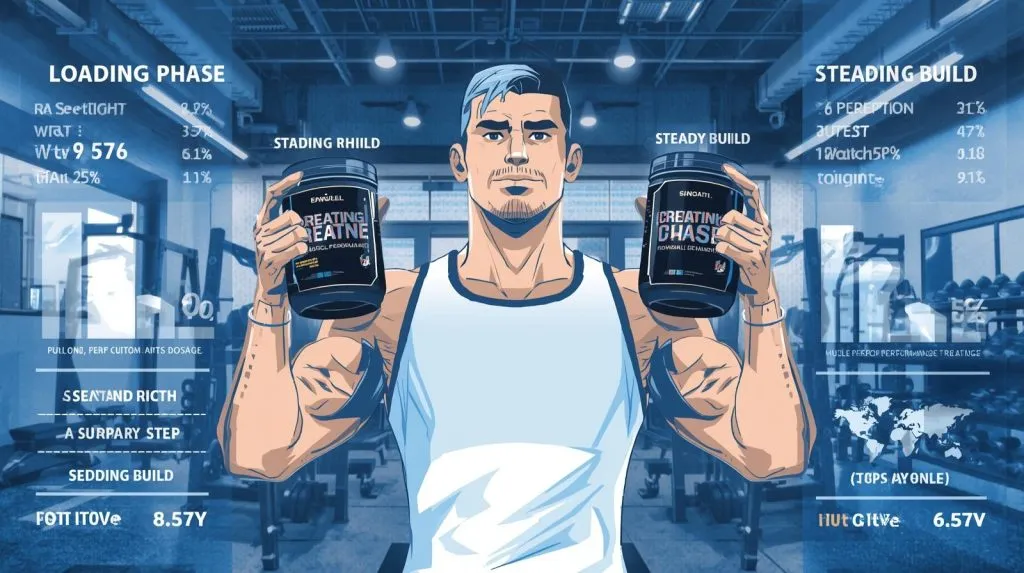
Loading Phase (What Most People Do)
Dosage Schedule:
- Days 1-7: 20-25g per day (split into 4-5 doses)
- Day 8 onward: 3-5g per day (single dose)
Advantages:
- ✓ Faster results (muscle saturation in 1 week vs 4 weeks)
- ✓ Notice strength improvements sooner
- ✓ Better for athletes preparing for competition
- ✓ More exciting initial progress
Disadvantages:
- ✗ Requires strict dosing schedule
- ✗ Slightly higher water retention first week
- ✗ More expensive first week
- ✗ GI upset risk if not taken with food/carbs
Best for: People who want quick results and don’t mind the extra effort
Steady Build (Simpler Approach)
Dosage Schedule:
- Every day: 3-5g per day (single dose)
- Duration: 21-28 days to reach saturation
Advantages:
- ✓ Simplest protocol (one dose daily)
- ✓ More cost-effective over first month
- ✓ Lower risk of GI issues
- ✓ More consistent creatine levels
- ✓ Doesn’t require food timing
Disadvantages:
- ✗ Takes 3-4 weeks to see results
- ✗ Requires patience
- ✗ Less progress initially visible
Best for: People who prefer simplicity and don’t mind waiting for results
Recommended Daily Creatine Dosage: Special Populations

Creatine Dosage for Muscle Growth
Your dosage doesn’t change based on whether you’re chasing muscle gains vs strength. The same 3-5g daily (maintenance) supports:
- Muscle protein synthesis enhancement
- Improved training volume tolerance
- Better muscle pump and fullness
- Increased total body water (cell volumization)
- Enhanced ATP regeneration for hypertrophy-focused rep ranges
Pro tip: Combine creatine with consistent resistance training + adequate protein (1.6-2.2g per kg bodyweight) for maximum muscle-building results.
Creatine Dosage for Strength
Similarly, strength athletes use the same maintenance dosage:
- 3-5g daily
- Supports ATP regeneration for maximal strength attempts
- Improves training capacity for powerlifting/strongman
- Enhances muscular endurance
- Supports neuromuscular efficiency
Pro tip: Strength athletes may benefit more from loading phase for faster saturation, as competition timelines are often shorter.
Creatine Dosage for Vegetarians/Vegans
If you’re vegetarian or vegan, you have approximately 50% lower natural creatine intake from food compared to meat-eaters. This means:
- Loading phase is recommended (faster saturation)
- Consider staying at lower end of maintenance (3g vs 5g)
- Results may be more noticeable initially
Creatine Dosage for Older Adults (40+)
Older adults can use standard dosages. Research suggests:
- Same loading protocol: 0.3g per kg for 5-7 days
- Same maintenance: 0.03g per kg daily
- Creatine may provide additional cognitive benefits at this age
- Combined with resistance training, supports muscle mass preservation
Creatine Dosage Myths Debunked

Myth 1: Higher Dosage = Better Results
Truth: Once muscles are saturated with creatine, additional dosage provides no additional benefit. It’s like filling a cup—once full, more water just spills over. Standard maintenance dosages maximize the benefit.
Myth 2: Women Shouldn’t Take Creatine
Truth: Women benefit equally from creatine. The dosage may be slightly adjusted for body weight and absorption patterns, but effectiveness is identical. It supports strength, muscle endurance, and cognitive function.
Myth 3: You Must Cycle Creatine
Truth: Cycling is unnecessary. Your body naturally produces creatine daily. Supplementing doesn’t suppress production. You can take 3-5g daily indefinitely without losing effectiveness.
Myth 4: Creatine Dosage Affects Kidney Health
Truth: Decades of research shows creatine at recommended dosages is safe for healthy individuals. Even at 5-20g daily for years, no kidney damage occurs. (People with pre-existing kidney disease should consult their doctor.)
Myth 5: Loading Phase Dosage is Required
Truth: Loading is optional. It just speeds up results. Steady building (3-5g daily) achieves identical long-term results—it just takes 3 weeks instead of 1 week.
FAQ About Creatine Dosage

What if I miss a day of my creatine dosage?
One missed day won’t significantly impact muscle saturation. Just resume your normal dosage the next day. Consistency matters more than perfection.
Should I take my daily creatine dosage with food?
Yes, ideally. Taking creatine with carbs and protein enhances absorption through insulin-mediated mechanisms. A meal, shake, or even juice works. Never take on an empty stomach.
Can I change my dosage mid-cycle?
Yes. If you increase your maintenance dosage from 3g to 5g, you’ll reach a higher saturation level in 2-3 weeks. If you decrease, you’ll drop to the lower level. But don’t exceed 5g daily maintenance—there’s no benefit.
What’s the best time to take creatine dosage daily?
Timing is less important than consistency. Morning, evening, post-workout—any time works. Some research suggests post-workout with carbs/protein is slightly optimal, but the difference is minimal if you’re consistent.
Do different creatine forms affect dosage?
Creatine monohydrate (standard) is what research recommends. Dosages in this guide apply to creatine monohydrate. Other forms (buffered, ethyl ester, etc.) are either untested or show no advantage. Stick with monohydrate—it’s cheapest and most researched.
How long until I see results from my dosage?
Loading phase: 3-5 days (faster results visible)
Steady build: 14-21 days (gradual improvements)
Full saturation: 21-28 days (maximum benefits)
Should my creatine dosage change if I take a break?
If you stop taking creatine, muscle levels drop by ~50% in 3-4 weeks. Restarting uses the same dosage protocol. If you take a 1-2 week break, you can restart with loading phase for faster results.
Is creatine dosage safe for teenagers?
Yes. Research shows creatine is safe for athletes 13+. Dosage is based on body weight (so naturally lower for smaller bodies). Consult a doctor, but there are no known long-term safety issues.
Optimal Creatine Dosage Summary Table
| Population | Loading Phase | Maintenance | Duration |
|---|---|---|---|
| Men (average) | 20-25g/day | 5g/day | 5-7 days loading |
| Women (average) | 15-20g/day | 3-4g/day | 5-7 days loading |
| Heavier athletes (200+ lbs) | 25-30g/day | 5g/day | 5-7 days loading |
| Lighter athletes (130-150 lbs) | 15-18g/day | 3-4g/day | 5-7 days loading |
| Vegetarians/Vegans | 20-25g/day | 5g/day | 5-7 days loading |
| Older adults (40+) | 20-25g/day | 3-5g/day | 5-7 days loading |
The Bottom Line
Your best creatine dosage depends on your body weight, gender, and goals—which is why our calculator personalizes your recommendation.
General rule:
- Loading phase (optional but effective): 0.3g per kg of bodyweight daily for 5-7 days
- Maintenance phase (required): 0.03g per kg of bodyweight daily
For most people: 20-25g daily loading (split into 4-5 doses), then 3-5g daily maintenance.
Use the calculator above to find your exact dosage, then combine it with proper hydration (use our Water Calculator) and consistent training for optimal creatine results.
Resources
- International Society of Sports Nutrition (ISSN) – Creatine Supplementation Position Stand
- Journal of the International Society of Sports Nutrition – Research on Creatine Dosing
- NIH/PubMed – Creatine Safety and Efficacy Studies
- Your healthcare provider – Before starting supplementation
Next Steps
- Use our calculator above to find your personalized dosage
- Calculate your water intake using our Creatine Water Calculator
- Start your creatine protocol – choose loading or steady build
- Track your progress – measure strength and body composition changes
Disclaimer: This article is for educational purposes. Always consult with a healthcare provider before starting any supplement regimen, especially if you have pre-existing health conditions or take medications.