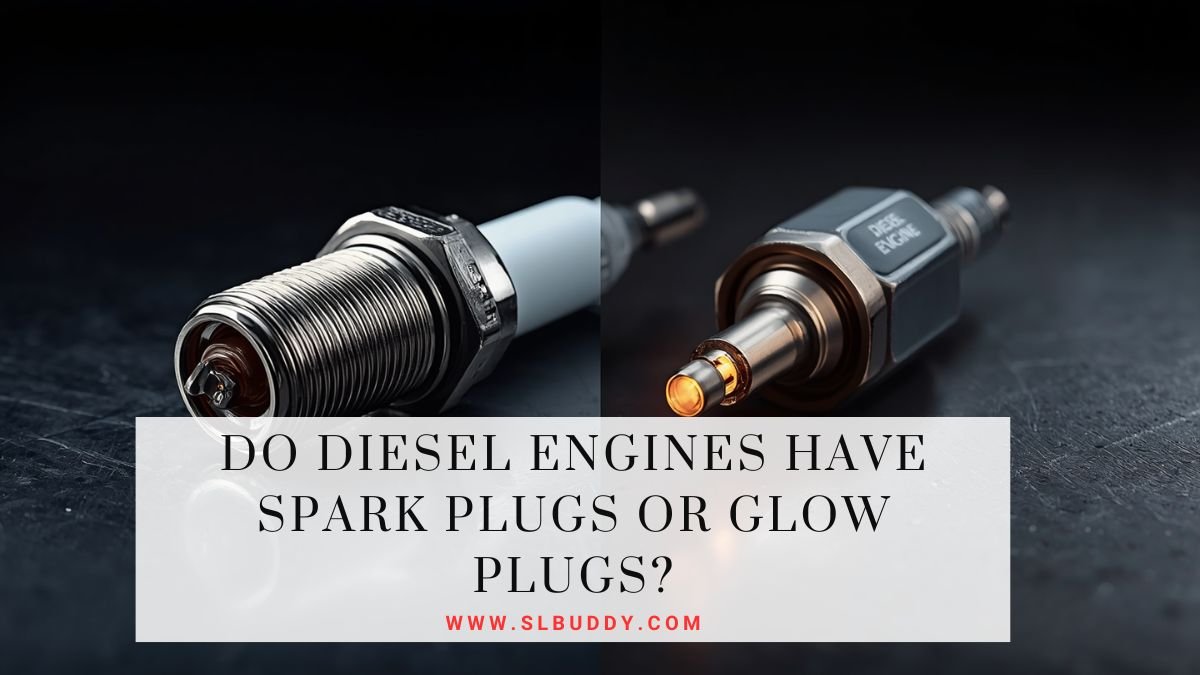
Quick Answer: Diesel engines do NOT have spark plugs. Instead, they use glow plugs, small electric heating elements that warm the combustion chamber before a cold start. Once the engine reaches operating temperature, it runs entirely on compression ignition, which means no plug of any kind fires continuously. Gasoline engines are the ones that need spark plugs, and they need them constantly while running.
If you’ve ever popped the hood on a diesel truck expecting to find spark plugs, welcome to the club. It’s one of the most common questions new diesel owners ask, and honestly, it makes sense to wonder. Let’s break it all the way down.
Why Diesel Engines Don’t Need Spark Plugs
To understand why diesel skips the spark plug entirely, you need to understand what a spark plug actually does and why diesel fuel makes it unnecessary.
In a gasoline engine, air and fuel are mixed together before they enter the cylinder. That mixture is highly flammable, but not flammable enough to ignite on its own under normal pressure. So the spark plug fires at exactly the right moment, thousands of times per minute, to trigger combustion. Without it, your gas engine is just a big paperweight.
Diesel works completely differently. A diesel engine pulls in only air into the cylinder, then squeezes it with an extreme amount of force. We’re talking compression ratios of 14:1 to 25:1, compared to a gasoline engine’s typical 8:1 to 12:1. When you compress air that aggressively, it gets extraordinarily hot, hot enough to ignite diesel fuel the moment it’s injected into the cylinder.
This process is called compression ignition, and it’s the entire foundation of how diesel engines operate.
The physics behind it: Diesel fuel has an auto-ignition temperature of around 410°F (210°C). When compressed at a ratio of 14:1 or higher, the air inside the cylinder easily exceeds that threshold. The fuel doesn’t need a spark — it ignites on contact with the superheated air.
So a spark plug in a diesel engine wouldn’t just be unnecessary, it would be pointless. The combustion has already been triggered by heat and pressure alone before any spark could even fire.
So, Where Do Glow Plugs Come In?
Here’s where people get confused: if diesel doesn’t need a spark plug, why do glow plugs exist at all?
The answer is cold weather.
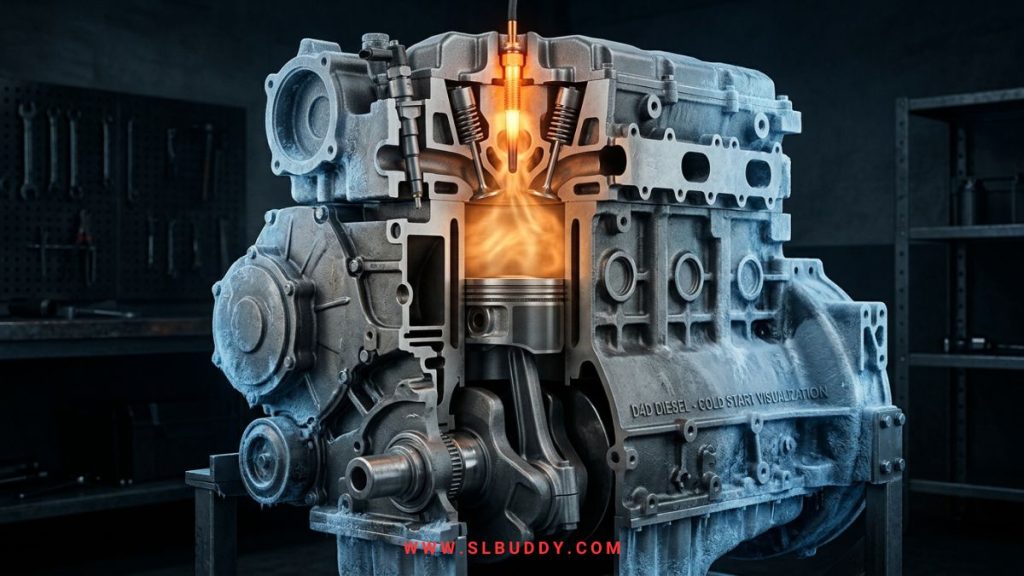
Compression ignition works great once the engine is warm. The metal cylinder walls hold heat, the air compresses to sufficient temperatures, and everything runs smoothly. But on a cold morning, especially in freezing conditions, that same metal absorbs heat away from the compressed air before ignition can happen. The temperature in the combustion chamber drops below what’s needed to fire the fuel, and the engine struggles to start or won’t start at all.
Glow plugs solve this problem. They’re small pencil-shaped heating elements, one per cylinder, that sit inside the combustion chamber and preheat the air before the starter motor cranks. Modern glow plugs can reach temperatures of 1,500°F to 1,832°F in just 2–5 seconds. That gives the compressed air the thermal boost it needs to ignite the diesel fuel reliably, even in subfreezing temperatures.
Once the engine warms up and generates its own heat through combustion, the glow plugs switch off. They’re a starting aid, not a continuous ignition source like spark plugs are.
You’ve probably seen this in action without realizing it: that little coil-shaped light on your diesel dashboard that glows for a few seconds before you start the engine? That’s your glow plug system at work. When the light goes out, the plugs have done their job and the engine is ready to crank.
Spark Plugs vs. Glow Plugs: A Side-by-Side Comparison
| Feature | Spark Plug | Glow Plug |
|---|---|---|
| Engine type | Gasoline (petrol) | Diesel |
| Function | Creates a spark to ignite air/fuel mix | Heats combustion chamber for cold starts |
| When it works | Continuously while engine runs | Only during startup and warm-up |
| Ignition method | Electrical arc / spark | Electrical heat element |
| Compression ratio needed | 8:1 to 12:1 | 14:1 to 25:1 |
| Replacement interval | Every 30,000–100,000 miles | Every 60,000–100,000 miles |
| Role after warmup | Still firing every cycle | Switched off entirely |
| Operates without it? | Engine won’t run | Engine may start in warm weather |
How Compression Ignition Actually Works (Step by Step)
Here’s exactly what happens inside a diesel cylinder every time it fires:
- Intake stroke — The piston moves down, and the intake valve opens. Only air enters the cylinder, no fuel yet.
- Compression stroke — The intake valve closes. The piston moves back up and compresses the air to roughly 1/20th of its original volume. The air temperature skyrockets.
- Power stroke — At the top of the compression stroke, the fuel injector sprays a precisely measured mist of diesel fuel into the superheated air. The fuel auto-ignites immediately, driving the piston back down with considerable force.
- Exhaust stroke — The piston comes back up and pushes the burnt gases out of the cylinder.
This happens hundreds of times per minute, per cylinder. No spark required at any stage. The glow plug’s job is done long before step one even begins.
What makes this system impressive is that diesel engines achieve greater thermal efficiency than gas engines partly because of those high compression ratios. More compression means more energy extracted from each drop of fuel, which is one reason diesel-powered trucks and equipment consistently deliver better fuel economy over long hauls.
Not Every Diesel Uses Glow Plugs. Here’s What They Use Instead
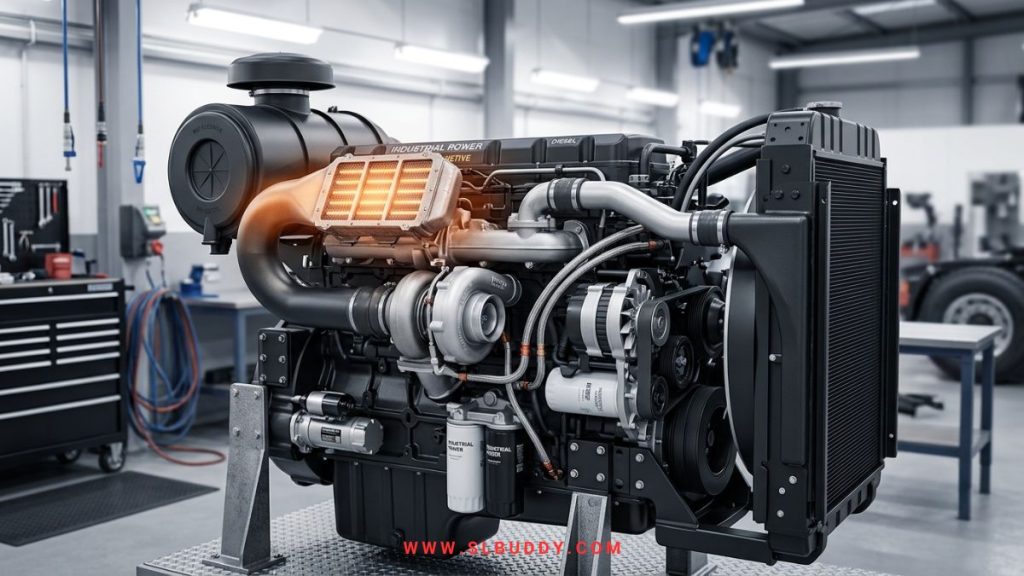
It’s worth knowing that glow plugs aren’t universal across all diesel engines. Some diesel systems, particularly larger industrial and commercial engines, use a different approach called an intake air heater or grid heater.
Instead of warming each individual cylinder with its own plug, an intake air heater warms the incoming air before it even enters the cylinders. The result is similar: the combustion chamber reaches ignition temperature more easily on a cold start. If you look at a diesel engine and can’t find glow plugs, don’t panic. The engine likely uses one of these alternative pre-heating methods.
Direct injection diesel engines also tend to have better cold-start performance than older indirect injection designs, sometimes requiring glow plug assistance only at lower ambient temperatures (0°C and below for many modern direct-injection setups).
Signs Your Diesel’s Glow Plugs Are Failing
Since glow plugs are most critical during cold starts, their failure symptoms tend to cluster around exactly that scenario. Here’s what to watch for:
1. Hard starting in cold weather. This is the big one. If your diesel cranks and cranks but won’t fire on a cold morning, and starts fine once the weather warms up, a failing glow plug is a prime suspect. The combustion chamber simply isn’t reaching ignition temperature.
2. Rough idle or misfiring right after startup. A cylinder without adequate heat during startup won’t combust cleanly. You might feel the engine stumble, shake, or run unevenly for the first minute or two. This usually clears up as the engine warms itself through combustion. That “clearing up” is the clue; it’s a cold-start issue, not a fuel or mechanical one.
3. White or blue smoke from the exhaust on startup. White smoke at startup means unburned diesel fuel is passing through and vaporizing in the exhaust. It’s the smell of incomplete combustion, diesel that never got hot enough to ignite properly. A small amount of white smoke on a very cold morning is normal; excessive clouds that linger well past startup are a warning sign.
4. Black smoke. Less common with glow plug issues specifically, but a faulty plug can disrupt the air-fuel ratio enough to produce black smoke from excess unburned fuel.
5. Check engine light / glow plug warning light Modern diesels monitor the glow plug circuit in real time. If a plug fails or its resistance reads out of range, the ECU logs a diagnostic trouble code, most commonly P0380 (glow plug/heater circuit malfunction) or P0671 through P0678 for individual cylinder faults on V8 engines. A scan tool will tell you exactly which cylinder is the problem.
6. Poor fuel economy. When combustion is incomplete because the chamber isn’t hot enough, the engine compensates by consuming more fuel to maintain performance. Subtle but real, and it adds up over time.
How Long Do Glow Plugs Last? (And What Does Replacement Cost?)
Glow plugs are actually pretty durable compared to spark plugs. Most manufacturers rate them for 60,000 to 100,000 miles, with modern ceramic-tipped glow plugs sometimes lasting well beyond that under ideal conditions. Metal-sheathed plugs tend to fall toward the lower end of that range.
A few factors affect lifespan:
- Climate — Diesel owners in cold climates cycle their glow plugs far more often than those in warm regions. More cycles = more wear.
- Driving habits — Frequent short trips that never fully warm the engine are harder on glow plugs than long highway runs.
- Plug quality — OEM-quality plugs from manufacturers like DENSO, Bosch, or NGK will typically outlast budget alternatives.
Replacement costs vary considerably by vehicle and region. Parts alone run roughly $10–$50 per plug for most light-duty applications. Labor can add $100–$200 per plug at a shop, depending on how accessible the plugs are. On some engines, a 6.0 Power Stroke with tight cylinder head clearance, for instance, labor costs can get steep.
The smart move: Replace all glow plugs at once, even if only one has failed. They’re installed together and wear at similar rates. Replacing just one today and returning to the shop six months later for another costs more in labor than doing the full set in one visit.
Can You Put a Spark Plug in a Diesel Engine?
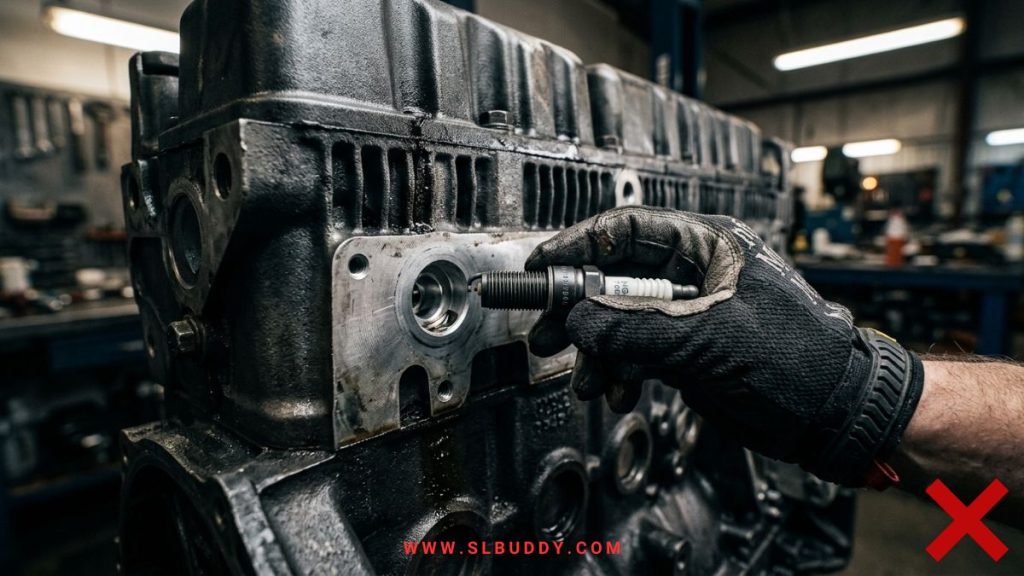
No, and not just because it “won’t work.” Spark plugs and glow plugs are mechanically incompatible. They’re different sizes, different thread pitches, different designs. A spark plug physically cannot thread into a glow plug port on a diesel cylinder head.
Even setting aside the fitment issue, a spark plug would serve no useful function in a diesel engine. The combustion process doesn’t involve a timed electrical arc; it’s driven entirely by heat and compression. An installed spark plug (if it somehow fit) would just sit there doing nothing while the engine ignored it.
The reverse is also true: a glow plug in a gasoline engine would be equally useless and potentially damaging. Gasoline engines don’t compress air hot enough to use compression ignition, and the glow plug wouldn’t time its heat delivery to the combustion cycle anyway.
They are purpose-built for fundamentally different combustion systems.
What About the Mazda SkyActiv-X? (A Quick Sidebar)
You might have heard about Mazda’s SkyActiv-X gasoline engine, which uses a form of compression ignition. It’s one of the rare exceptions where a gas engine borrows the diesel approach. But even here, it still uses a spark plug. The spark is just used for precise timing control of the compression-ignition event, not as the primary ignition source. It’s a clever workaround for the challenges of making gasoline behave like diesel.
It’s the exception that proves the rule: getting compression ignition to work reliably with gasoline is hard. Diesel was designed for it from the ground up.
Quick Reference: Gas vs. Diesel Ignition at a Glance
| Question | Gas Engine | Diesel Engine |
|---|---|---|
| Has spark plugs? | ✅ Yes | ❌ No |
| Has glow plugs? | ❌ No | ✅ Yes (most) |
| How does fuel ignite? | Spark from plug | Compressed heat |
| Compression ratio | 8:1 – 12:1 | 14:1 – 25:1 |
| Plugs fire continuously? | Yes (spark plugs) | No (glow plugs off after warmup) |
| Cold weather starting aid? | None needed | Glow plugs preheat chamber |
The Bottom Line
Diesel engines don’t have spark plugs, full stop. They rely on the physics of extreme compression to generate enough heat to ignite fuel without any electrical spark. Glow plugs exist as a supporting system for cold-weather starts, warming the combustion chamber just enough to give compression ignition the thermal head start it needs.
Once a diesel is warm, it runs entirely on heat, pressure, and mechanical timing. No spark, no continuous plug firing, just controlled explosions of compressed air and injected fuel, cycle after cycle.
If you’re doing maintenance on a diesel and wondering where the spark plugs are, you can stop looking. They were never there to begin with.
Do all diesel engines have glow plugs?
Not all. Some diesel engines use intake air heaters or grid heaters instead of individual cylinder glow plugs. The goal is the same, preheat the incoming air, just achieved differently.
Can a diesel engine start without glow plugs?
In warm weather, often yes. Compression alone can generate enough heat when ambient temperatures are high and the engine’s metal components don’t absorb as much heat. In cold conditions, a diesel with failed glow plugs will usually struggle to start or won’t start at all.
How do I know if my glow plugs are bad?
Look for hard cold starts, rough idle after startup, white exhaust smoke on cold mornings, and check engine codes P0380 or P0671–P0678.
How often should I replace diesel glow plugs?
Most manufacturers recommend every 60,000 to 100,000 miles. When one fails, replace the full set; they wear at similar rates and labor costs overlap.
What’s the glow plug light on my diesel dashboard?
It’s a coil-shaped warning light that tells you the glow plugs are preheating. Wait for it to go out before cranking the engine. If it stays on or flashes, have the system diagnosed.