The short answer: teachers spend their summers doing a lot more than people think. According to a survey of 366 teachers, 76% attend professional development workshops and courses, 86% spend time preparing for the next school year, and nearly 1 in 2 take on a second job. The average teacher’s summer break is just nine weeks, not three months, and most teachers work more than 20 hours per week during that window, even without setting foot in a classroom.
So no, they’re not eating bon-bons by the pool. But they’re also not working 8 to 3 with nowhere to be. The summer reality for most teachers sits somewhere in between, and it looks pretty different depending on the person, the grade level, the subject, and whether the district hands them a paycheck in July or doesn’t.
Let’s get into all of it.
First, How Long Is Teacher Summer Break, Really?
The “three months off” myth needs to die. Most people picture teachers clocking out on the last day of school in late May and walking back through the door in September. That’s not what the calendar looks like for most educators.
62% of teachers report that their summer break, the stretch between the last contract day of one school year and the first day of in-service for the next, is just about nine weeks. And that’s before accounting for in-service training days that eat into both ends of the break.
Here’s how a typical teacher summer calendar actually breaks down:
| Time Period | What’s Happening |
|---|---|
| Last week of school (May/June) | Grading finals, packing classrooms, end-of-year ceremonies |
| Week 1–2 of break | Decompression, catching up on life, actual rest |
| Weeks 3–7 | Professional development, curriculum planning, second jobs, travel |
| Week 8–9 | Classroom setup, back-to-school prep, mental gear-shift |
| Pre-service week (August) | District training days, meetings, curriculum review |
That middle stretch, weeks three through seven, is where the myth lives and where the reality gets interesting.
What Most Teachers Actually Do in the Summer

1. Professional Development (76% of Teachers)
76% of teachers spend part of their summer attending workshops, seminars, and courses to sharpen their skills. This isn’t optional for many states that require teachers to complete a set number of continuing education credits to maintain their license. But here’s the catch: the majority of this work is unpaid.
A teacher who spends three days at a curriculum workshop in July isn’t getting a bonus check. They’re investing their own time and sometimes their own money- to stay licensed and stay current. The professional development requirements don’t pause because school is out. And with education constantly evolving, new reading frameworks, updated math standards, technology integrations- summer is often the only realistic window to dig into new methods without the pressure of 25 students waiting for the next activity.
What does summer PD actually look like? It varies:
- Content-area workshops: A science teacher attending a two-week STEM institute at a local university
- Technology training: Learning a new curriculum platform or classroom management tool
- Graduate coursework: Working toward a master’s degree or specialist certification (which also increases salary)
- Curriculum writing: Some teachers are paid a small stipend to help write new district curriculum over the summer
- Conferences: Regional or national education conferences where teachers present or attend sessions
- Mandated training: New teacher induction programs, special education compliance training, literacy framework workshops required by the district
The unpaid reality matters here. The RAND Corporation’s 2025 State of the American Teacher survey found that teachers reported working an average of 49 hours per week during the school year, and summer professional development extends that uncompensated labor into what’s supposed to be a break.
2. Planning and Classroom Prep (86% of Teachers)
86% of teachers spend part of their summer preparing for the next school year. This one surprises people the most.
When a new school year starts in late August, teachers are expected to walk into a fully functioning classroom: walls decorated, supply systems organized, seating charts considered, first-week lessons ready, and parent communication templates drafted. None of that happens by magic. Most of it happens in the summer.
A 2014 study by economics professor Kristine L. West found that during the summer, teachers work an average of more than 20 hours per week, with a significant chunk of that time going toward planning for the upcoming year.
What does summer planning actually involve?
- Reviewing standards for the new grade or course
- Ordering and organizing supplies (often with personal money, teachers spend an average of $479 of their own money on classroom supplies each year, according to the National School Supply and Equipment Association)
- Building out unit plans and pacing guides for the full year
- Creating or updating classroom systems, anchor charts, and procedures
- Reading new textbooks or resource books
- Setting up digital classroom spaces (Google Classroom, Seesaw, Canvas)
- Writing new lessons for the changed curriculum requirements
- Redesigning classroom layout for a new grade or space
For teachers who change grade levels, get a new classroom, or are assigned a new subject, which happens more often than people realize, summer prep can feel like starting from scratch.
3. Working a Second Job (Nearly 1 in 2 Teachers)
49% of teachers plan to get a second job during the summer. This isn’t a fringe behavior, it’s nearly the norm.

About 1 in 6 US teachers work second jobs year-round, not just in summer. Teachers with less experience are disproportionately likely to work summer jobs 35% of teachers with one year of experience or less worked a non-school job in the summer, compared to just 13% of teachers with 30 or more years of experience.
The reason is straightforward: teacher pay doesn’t always cover the bills, especially for early-career educators in states with lower salary schedules. And depending on how a district structures its payroll, summer may bring either a smaller paycheck or no paycheck at all.
Common summer jobs teachers take:
| Job Type | Why Teachers Choose It |
|---|---|
| Tutoring | Uses existing skills, flexible schedule, good hourly rate |
| Summer school teaching | Familiar environment, district-paid |
| Summer camp counselor or director | Works with kids, often fun |
| Curriculum writing (district contract) | Education-adjacent, paid stipend |
| Freelance writing or editing | Uses grammar and communication skills |
| Selling lesson plans online | Passive income, leverages existing work |
| Real estate | License is earnable in spare time, flexible |
| Retail or food service | Completely different from teaching, mental break |
| Online course creation | Leverages subject expertise for long-term income |
| Coaching or instruction | Sports, music, arts — uses existing skills |
Male teachers were more likely than female teachers to work summer jobs (22% vs 14%), and secondary school teachers were slightly more likely than elementary school teachers to take on summer work.
4. Teaching Summer School
Summer school is a significant part of the picture for many teachers, and it’s growing. Almost three-quarters of district superintendents said they offer programs for students who qualify for remediation, according to a 2025 survey from AASA, the School Superintendents Association, Gallup, and the National Summer Learning Association.
That means a lot of teachers are back in classrooms, teaching reading intervention programs, credit recovery courses, enrichment sessions, or specialized STEM camps, well before the official school year begins. Summer school is typically paid separately from the regular contract, so it’s genuinely extra income rather than deferred salary.
For teachers who love their work but need the income, summer school is often the ideal setup: familiar students, focused curriculum, shorter days, and a real paycheck.
5. Resting and Recovering (And This Is Actually Important)

Let’s not skip over this one. After 180+ school days of managing a classroom full of children, navigating behavior issues, hitting curriculum standards, differentiating instruction for students at six different levels, communicating with parents, sitting through staff meetings, and handling the emotional labor that comes with working with young people, teachers are genuinely tired.
The RAND Corporation found that teachers in 2025 were more likely than similar working adults to report experiencing poor well-being on every measured indicator, a consistent pattern since 2021. Female teachers in particular showed a widening gap in job-related stress compared to male teachers, a 22-percentage-point difference in 2025, bigger than in any other profession.
Summer isn’t just a perk. For many teachers, it’s the reason they can return to the classroom in August without completely burning out. Pediatric and adolescent mental health experts consistently note that the adults who work with children need emotional recovery time just as much as the children do.
What does rest look like for teachers?
- Sleeping past 5:45 AM for the first time in ten months
- Reading books that aren’t for work
- Traveling — the flexible summer schedule is genuinely one of teaching’s best perks
- Exercising without a 4 AM alarm
- Spending real time with their own children, who are also off school
- Doing literally nothing, guilt-free, for at least a few days
The research backs this up: the share of teachers who intended to leave their jobs fell to 16 percent in 2025 from 22 percent in 2024, likely partly because teachers who got adequate summer recovery returned to the job rather than leaving it.
6. Personal and Family Life
Teachers are people. This one shouldn’t need its own section, but given how much the “paid vacation” narrative dominates public perception, it’s worth saying plainly: teachers use summer to live their lives.
Home renovations that require someone to be home. Medical appointments that couldn’t be scheduled during the school year. Finally visiting family members who live far away. Attending children’s events that always conflicted with school hours. Pursuing hobbies that required daylight. Getting married. Moving. Dealing with aging parents. Starting a side business.
All the things that working adults do, teachers do them in summer because they simply can’t during the academic year. The inflexibility of a school schedule is total during the year. You can’t take a Thursday afternoon in March to handle a personal matter the way someone in an office job might be able to rearrange their calendar. Summer is when that flexibility returns.
Read more: What Is the Main Purpose of Developing a Business Pitch?
Do Teachers Get Paid in the Summer?
This is the most searched follow-up question to “what do teachers do in the summer,” and the answer is: it depends on the district.

A teacher’s annual salary is based on a fixed number of contract days, typically between 185 and 200, rather than a year-round work schedule. The only question is when the money hits the bank account.
There are two main structures:
| Pay Structure | How It Works | Summer Paycheck? |
|---|---|---|
| 10-month pay | Full salary paid out September–June, in larger paychecks | No — nothing arrives in July or August |
| 12-month pay | Same annual salary divided into 12 smaller monthly payments | Yes — but it’s deferred salary, not bonus pay |
Under the 12-month option, the money paid during summer is not a bonus or separate compensation — it is deferred salary from work already performed. Teachers on this plan are receiving money they already earned; it’s just being distributed over a longer period to smooth out cash flow.
Teacher payroll schedules vary district-to-district: some allow workers to spread their 10-month salary over 12 months, while others don’t give any paycheck during the summer months, requiring teachers to budget or, in some cases, get a second job.
For teachers on the 10-month structure without a summer school contract, July and August bring zero income. That’s a real financial planning challenge, especially for newer teachers with lower base salaries and student loan payments.
Summer by Teacher Type: Who Does What
Not all teachers spend summer the same way. Here’s how the experience varies:
| Teacher Type | Typical Summer Focus |
|---|---|
| Elementary (K-5) | Classroom prep, reading/literacy PD, family time |
| Middle school | Content-area PD, transition planning, second jobs |
| High school | Graduate coursework, curriculum writing, second jobs |
| Special education | IEP prep, compliance training, coordination with services |
| New teachers (0-3 years) | Surviving, planning, often working second jobs |
| Veteran teachers (10+ years) | Travel, mentoring new teachers, selective PD |
| Department heads / coordinators | Curriculum meetings, textbook review, leadership training |
| Year-round school teachers | Shorter, rotating breaks rather than one long summer |
Subject area also shapes the summer experience. A music teacher may spend the summer directing youth bands or giving private lessons. A physical education teacher might be coaching summer sports. A technology teacher may pick up freelance IT work. An English teacher may actually be writing for publication, for freelance clients, or for curriculum.
What Teachers Wish People Understood About Summer
Here’s what comes up again and again when teachers talk candidly about this topic:
“Summer is how I recharge enough to come back.” This isn’t laziness, it’s sustainability. Teaching is one of the highest-stress professions in the US by multiple measures. The summer break is the structural mechanism that allows teachers to return to the job rather than leave it. Eliminating or shortening summer break without addressing the conditions that make the job this exhausting wouldn’t produce better teachers. It would accelerate the attrition crisis.
“I spend my own money to prepare.” Summer planning doesn’t come with a budget. Teachers who redesign their classroom environment, build new curriculum units, or invest in professional books for summer reading are doing so largely on their own dime. The average teacher spends hundreds of dollars of personal income on classroom supplies and materials annually.
“I’m still thinking about my students.” There’s a reason people joke that teachers are always on. Summers are quieter, but a student who struggled all year doesn’t stop being a concern the day school ends. Many teachers reach out to families over the summer, connect students with resources, or simply carry the weight of worrying about kids in difficult home situations.
“The planning isn’t optional.” The idea that summer planning is excessive or self-inflicted is a misconception. Standards don’t write themselves into lesson plans. New textbooks need to be read before they’re taught. New curriculum mandates need to be understood before the first week of school. If teachers didn’t plan in summer, the first weeks of school would be chaotic by design.
A Realistic Week-in-the-Life: Teacher Summer Edition
Here’s what an average week in mid-July might look like for a 7th grade English teacher:
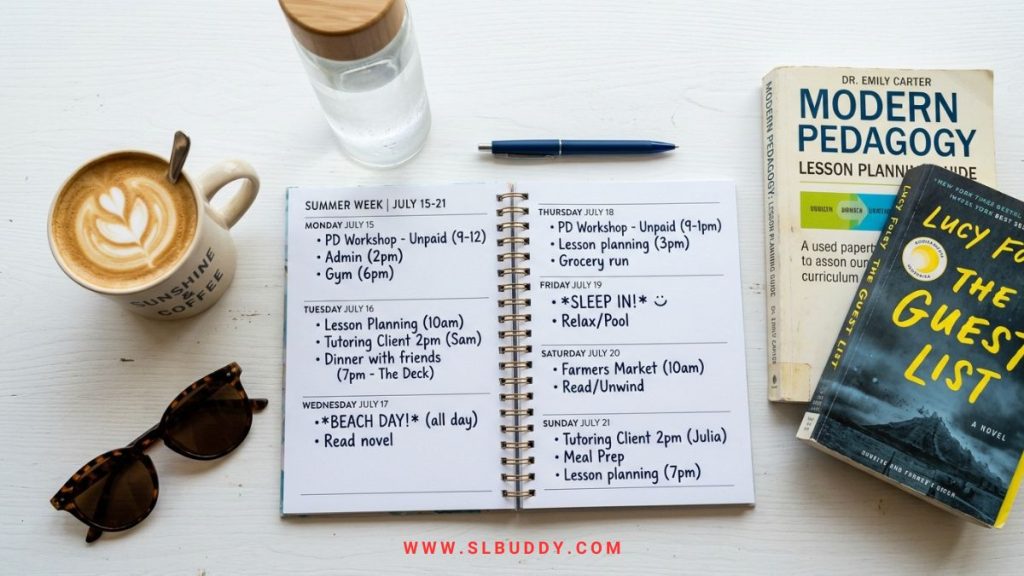
Monday: Sleep in until 7:30. Coffee. Spend the morning revising the first unit’s anchor text selections for the new year. Order three books for the classroom library. Afternoon: gym, grocery shopping, dinner with family.
Tuesday: Full-day professional development workshop on the Science of Reading framework. Unpaid but required for license renewal. Drive 40 minutes each way.
Wednesday: Tutoring session (private client, 2 hours, $70/hr). Then three hours planning the first six weeks of the new school year at the kitchen table.
Thursday: Completely off. Beach day. Read a novel that has nothing to do with school.
Friday: Morning lesson planning. Afternoon: meet with a colleague to co-plan a new unit on argumentative writing. Dinner out.
Weekend: Some errands, some rest, some Instagram scrolling that somehow becomes a rabbit hole of classroom decor ideas that result in two hours of unofficially planning a bulletin board.
This is a summer, not a vacation, not a workweek. Something in between. And it looks different every week depending on the PD schedule, the tutoring clients, and how much coffee is in the house.
Read more: Cheapest Online Courses for Teachers to Continuing Education
The Bottom Line
What do teachers do in the summer? The real answer:
- They rest — genuinely, and necessarily
- They plan — for the next 180 days of someone else’s children’s education
- They learn — at workshops, in courses, and through the slow reading of new professional books
- They work — second jobs, summer school, tutoring, curriculum writing
- They live — as people with families, interests, health needs, and a human requirement for downtime
The “three months off” framing misses all of this. Teachers are professionals doing a demanding job in a system that gives them nine weeks each year to breathe, grow, plan, and recover. Most of them use every bit of it.
Do teachers really get the whole summer off?
Most teachers get approximately nine weeks between the last contract day and the first in-service day of the next school year — not three full months. Both ends of the break are trimmed by school calendar realities, and many teachers spend significant time working during those nine weeks anyway.
Do teachers get paid during the summer?
It depends on the district. Teachers on a 12-month pay schedule receive paychecks year-round, but that money is deferred salary from work already performed — not additional compensation. Teachers on a 10-month schedule receive no paycheck in July and August unless they take on extra work like summer school or tutoring.
How many teachers work summer jobs?
Nearly 49% of teachers take on some form of paid work during the summer. About 1 in 6 teachers work second jobs year-round. Newer, lower-paid teachers are significantly more likely to work summer jobs than veteran teachers with higher base salaries.
What do teachers do to prepare for next school year?
86% of teachers spend part of their summer on preparation for the upcoming year — building lesson plans, organizing classrooms, reading new curriculum materials, updating digital spaces, and drafting parent communication templates, among other tasks.
Is summer professional development paid?
Often not. Most summer professional development — workshops, seminars, courses required for license renewal — is unpaid. Some districts pay stipends for specific training, and curriculum writing projects sometimes carry modest pay, but the majority of summer PD is teachers investing their own time without compensation.
Do teachers plan lessons over the summer?
Most do, though the amount varies significantly by teacher and by year. Research shows teachers average more than 20 hours per week of work during the summer, much of it devoted to planning. Some years require heavy planning (new grade, new subject, new curriculum); other years require less.
What are good summer jobs for teachers?
Popular options include private tutoring ($40–$100/hour), teaching summer school, curriculum writing for the district, summer camp direction, freelance writing or editing, selling lesson plans on platforms like Teachers Pay Teachers, and online course creation. Many teachers also pursue graduate coursework in summer to qualify for salary increases.