
Quick Answer: The main purpose of developing a business pitch is to communicate your business idea’s value clearly and persuasively, so the right people (investors, partners, or customers) are motivated to take a specific action, whether that’s funding your venture, signing a deal, or buying your product. But a pitch does something else people rarely talk about: it forces you to understand your own business better.
1. The One-Sentence Definition Most People Miss
Most articles will tell you a business pitch is “a concise presentation to attract investors.” That’s true, but it’s only half the story.

Here’s the fuller truth:
A business pitch is a strategic communication tool that serves two masters: your audience and yourself. Externally, it persuades people to act. Internally, it forces you to confront the hard questions about your business that you might otherwise avoid.
If you can’t explain your business in three minutes in a way that makes someone lean forward, you don’t have a pitch problem. You have a clarity problem. And that’s actually the pitch doing its job, telling you where the gaps are.
The 7 Core Purposes of a Business Pitch
Let’s go deeper than “to get funding.” Here are the seven real reasons you develop a business pitch and why each one matters.

Purpose 1: To Communicate Value Instantly
The world is noisy. Investors hear hundreds of ideas per year. Customers are bombarded with choices. Your pitch cuts through that noise by answering one question fast: Why does this business deserve attention?
Every second of a pitch should serve that question. If a slide doesn’t answer it, the slide shouldn’t exist.
Purpose 2: To Persuade a Specific Audience to Take Action
A pitch isn’t a report or a presentation for the sake of presenting. It’s built around a call to action: invest, partner, buy, or approve. The entire structure should funnel your audience toward that single decision.
This is why great pitches don’t end with “any questions?” They end with a clear next step: “We’re raising $500,000 in seed funding and we’re closing this round in 60 days. Are you in?”
Purpose 3: To Build Credibility and Trust
People don’t invest in ideas; they invest in people. A well-structured pitch signals that you understand the market, you’ve done the homework, and you know what you don’t know. That intellectual honesty builds more trust than a deck full of hockey-stick growth charts.
Citing real data, mentioning traction metrics, and acknowledging competition (rather than pretending it doesn’t exist) are all trust signals. Smart investors notice when founders skip them.
Purpose 4: To Clarify Your Own Strategy
This one is underrated and rarely discussed. The process of developing a pitch forces you to answer questions you’ve been avoiding:
- Who exactly is the customer? Not “small businesses” which ones, in which industries, with which pain points?
- What’s the revenue model and have you stress-tested it?
- Why now? What’s changed in the market that makes this the right moment?
- Why you? What gives your team the right to win in this space?
Many founders discover that preparing a pitch reveals a gap they didn’t know existed. That’s not failure, that’s the pitch doing exactly what it should.
Purpose 5: To Attract the Right Supporters (Not Just Any)
A pitch isn’t a broadcast. It’s targeted. A pitch crafted for a venture capitalist looks very different from one aimed at a strategic partner or an enterprise client. The purpose is the same persuasion, but the framing, language, and emphasis shift entirely.
A good pitch attracts the people who are genuinely the right fit, not just warm bodies in the room. Being specific about what you need actually filters out mismatched opportunities before they waste your time.
“Once the pitch lands and the partnership begins, keeping things organized matters; these free project management tools are built for early-stage teams.”
Purpose 6: To Open Doors for Future Conversations
Very few pitches close a deal on the spot. The real purpose is to earn the next conversation. A meeting, a follow-up call, a term sheet discussion, a pilot project. Think of your pitch as the trailer for a film, its job is to make people want to see the full movie.
The best founders measure a pitch’s success not just by the immediate “yes” but by the quality of the conversation it starts.
Purpose 7: To Stress-Test Your Business Model
When you stand in front of a room (or a Zoom call) and present your business to people who are paid to poke holes in it, you learn things about your model that months of solo planning won’t reveal. Questions like “what happens if your CAC doubles?” or “who’s your biggest competitor if Google enters this space?” sharpen your thinking in ways nothing else does.
In that sense, pitching is a research activity as much as a sales activity.
Types of Business Pitches (and Their Goals)
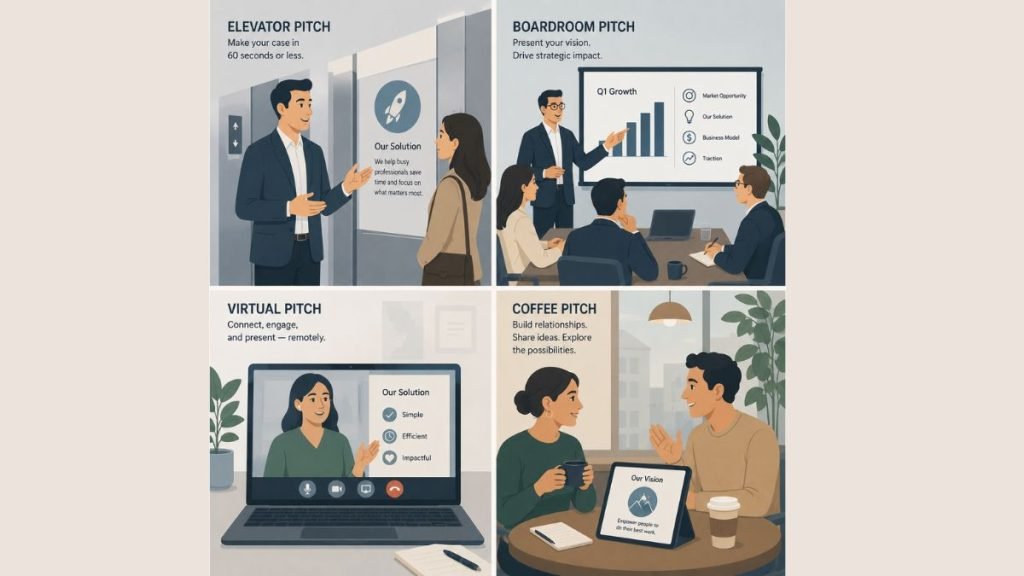
Not every pitch serves the same purpose. Here’s a breakdown of the most common types:
| Pitch Type | Primary Audience | Core Goal | Typical Length |
|---|---|---|---|
| Elevator Pitch | Anyone, anywhere | Spark curiosity, earn a follow-up | 30–60 seconds |
| Investor Pitch | Angel investors, VCs | Secure funding | 10–20 minutes |
| Sales Pitch | Potential customers | Close a deal or start a trial | 5–30 minutes |
| Partnership Pitch | Strategic partners | Establish mutual-benefit collaboration | 15–45 minutes |
| Internal Pitch | Leadership, board | Get budget or approval for a project | 10–20 minutes |
| Demo Day Pitch | Multiple investors | Stand out in a competitive room | 3–5 minutes |
Each type has a different primary purpose, but all share the same foundation: clarity, credibility, and a clear call to action.
4. What Makes a Pitch Different from a Business Plan?
This is a question that confuses a lot of first-time founders. They’re related, but they’re not interchangeable.

A business plan is comprehensive. It covers every aspect of your business in detail: financial projections, legal structure, operational workflows, risk analysis. It’s meant to be read, often by banks, grant committees, or internal stakeholders who need the full picture.
A business pitch is focused. It covers only what’s necessary to move your audience toward a decision. It’s meant to be experienced, heard, seen, felt. It leads with story and emotion, backed by evidence.
Think of it this way: a business plan answers “How does this business work?” A business pitch answers “Why should I care?”
One mistake founders make is turning a pitch into a mini business plan, cramming 40 slides worth of operational detail into what should be a 10-slide narrative. The result is an audience that glazes over, not one that’s excited.
5. The 5-Part Structure of a High-Converting Pitch
Whether you’re pitching to a solo investor or presenting at a demo day, the best pitches tend to follow a similar structure. Think of it as a story arc, not a checklist.
Part 1: The Hook (Slides 1–2)
Open with the problem, not your solution. Drop the audience into the pain point your target customer feels every day. Make it vivid. Make it specific. Numbers help: “87% of small business owners say invoice chasing is their #1 time drain” is more compelling than “businesses struggle with cash flow.”
Part 2: The Solution (Slides 3–4)
Now introduce your product or service as the answer to that specific problem. Keep it simple. One sentence if possible. Demo if you can. Don’t list features, show outcomes.
Part 3: The Opportunity (Slides 5–6)
Why is this a big deal? Show the market size, the timing, and the competitive landscape. Acknowledge competitors (pretending they don’t exist destroys credibility), but clearly explain what makes your approach better.
Part 4: The Team and Traction (Slides 7–8)
This is where many pitches lose investors. A brilliant idea in the hands of a team that can’t execute is worthless. Show that your team has the right mix of skills. Show early traction: users, revenue, pilots, letters of intent. Even small numbers signal momentum.
Part 5: The Ask (Slides 9–10)
Be specific. “We’re raising $750,000 to hire two engineers and scale our sales team over the next 18 months.” Vague asks make investors nervous. A clear ask with a clear use of funds signals maturity and planning.
6. Common Pitch Mistakes That Kill Deals
Even strong business ideas fail to get funded or supported because of avoidable pitch errors. Here are the most common ones:

Mistake 1: Leading with the product, not the problem If the first thing you say is “we built an app that does X,” you’ve already lost the audience. Lead with the pain, not the pill.
Mistake 2: Oversized market claims “Our TAM is $4 trillion” sounds impressive and meaningless. Investors want to see the realistic serviceable market, the slice you can actually reach and convert.
Mistake 3: Ignoring competition Saying “we have no direct competitors” signals naivety. Every problem has current solutions (even if those solutions are spreadsheets and phone calls). Acknowledge them and explain your edge.
Mistake 4: Death by data Slides packed with charts, stats, and footnotes don’t communicate confidence; they communicate anxiety. Curate your data. Every number should earn its place.
Mistake 5: A weak or missing ask If your pitch ends without a clear next step, the energy in the room dissipates. Know exactly what you want, and ask for it directly.
Mistake 6: Practicing once (or not at all) The best pitches sound effortless because they’ve been delivered dozens of times. Rehearsal reveals where your pacing breaks down, where you lose your train of thought, and where the audience disconnects.
7. Business Pitch Purpose by Audience: A Quick-Reference Table
| Audience | What They Want to Hear | What Action You’re Driving |
|---|---|---|
| Venture Capitalists | Scalability, market size, team, unit economics | Funding commitment |
| Angel Investors | Founder story, passion, early traction | First-check investment |
| Bank / Lender | Stability, cash flow, collateral, repayment plan | Loan approval |
| Enterprise Customer | ROI, security, integration, reliability | Pilot or contract |
| Strategic Partner | Mutual benefit, shared customer base | Partnership agreement |
| Internal Stakeholders | Cost, risk, strategic alignment | Budget or project approval |
Use this table as a calibration tool. Before any pitch, identify which column applies to your audience and shape your messaging accordingly.
8. Real-World Pitch Scenarios
Understanding pitch purpose in theory is one thing. Seeing how it plays out in real situations helps lock it in.

Scenario A: A Tech Startup at a Seed Round A two-person team has built an inventory management tool for independent retail stores. They’ve tested it with 12 early users and are seeing 30% reduction in stockouts. Their pitch purpose: secure $400,000 to hire a developer and a sales rep, and reach 200 paying customers in 18 months. Every slide serves that goal: the problem, the traction, the team, the ask.
Scenario B: A Freelancer Pitching a Corporate Client A brand designer pitches a mid-sized e-commerce company on a full brand refresh. Here, the pitch purpose isn’t funding, it’s trust. The designer leads with results from past work, listens to the client’s current brand frustrations, and positions the refresh as a revenue driver, not a cost center. The call to action: a signed proposal within two weeks.
Scenario C: An Internal Innovation Pitch A mid-level manager at a manufacturing company wants to pitch a shift to predictive maintenance software to reduce downtime. The audience is the executive team. The pitch purpose: get budget approval. The focus is ROI, implementation timeline, and risk mitigation, not features.
Three different settings. Three different audiences. One consistent underlying purpose: communicate value clearly and guide the audience toward a specific decision.
9. How to Start Building Your Own Pitch
If you’re starting from scratch, here’s a practical process to build a pitch that actually works:
Step 1: Lock down your “why now” statement What’s changed in the market that makes this the right moment for your business? Timing is one of the most persuasive elements of any pitch and one of the most overlooked.
Step 2: Write your one-sentence value proposition Complete this sentence: “We help [specific customer] do [specific outcome] without [specific pain or friction].” If you can’t finish that sentence clearly, the pitch isn’t ready.
Step 3: Gather your proof points Traction, testimonials, case studies, pilot results, letters of intent, whatever you have. Even small proof points matter. They signal execution, not just ideation.
Step 4: Build the narrative arc Use the 5-part structure above. Problem → Solution → Opportunity → Team + Traction → Ask. Don’t start with your company history. No one cares about your founding story until they care about your problem.
Step 5: Rehearse out loud, not in your head Rehearsing mentally feels productive but doesn’t reveal real problems. Stand up. Say it out loud. Record yourself. Watch it back. Notice where you hesitate, rush, or lose the thread.
Step 6: Pitch to someone who will push back Find an advisor, mentor, or even a smart friend who will ask the uncomfortable questions. Investors will. Better to face those questions in a safe environment first.
Step 7: Iterate Your first pitch will not be your best pitch. The best founders treat their pitch as a living document updated as the business grows, as feedback comes in, and as the market shifts.
If you’re building your pitch and need help structuring your business idea or financial model, explore the founder resources at slbuddy.com, practical tools for entrepreneurs who are serious about growth.
What is the single most important purpose of a business pitch?
To persuade your audience to take one specific action, whether that’s investing, signing a deal, or agreeing to a next meeting. Everything else in the pitch should support that single outcome.
How long should a business pitch be?
It depends on context. An elevator pitch is 30–60 seconds. A standard investor pitch deck is 10–20 minutes. A sales pitch can run longer if the audience is engaged. The rule of thumb: as short as possible while still covering everything necessary to earn the next step.
Can a business pitch help you even if you’re not looking for investors?
Absolutely. Internal pitches secure budget and resources. Customer pitches close deals. Partnership pitches unlock growth channels. The skill of pitching is valuable at every stage and in every direction.
What’s the difference between a pitch deck and a business pitch?
A pitch deck is the visual support material (slides). A business pitch is the full presentation: your narrative, delivery, energy, and Q&A responses. The deck supports the pitch; it doesn’t replace it. A poor presenter with a beautiful deck will lose to a confident founder with a simple one.
How do I make my pitch stand out?
Lead with a specific, vivid problem. Use real customer language. Show traction early. Acknowledge your competition honestly. Make a clear, specific ask. And rehearse until the delivery feels natural, not rehearsed.
Is developing a business pitch worth it for a small business?
Yes, even if you never stand in front of a VC. The process of developing a pitch forces clarity about your customers, your value proposition, and your revenue model. That clarity makes every business decision sharper.
Final Word
The main purpose of developing a business pitch isn’t just to impress a room full of investors. It’s to compress everything your business stands for into a clear, credible, compelling argument for why someone should act and to force yourself to truly understand your own business in the process.
A pitch that does both of those things well is one of the most powerful tools a founder can have.