If you’re searching for novel writing software that won’t break the bank, you’ve probably come across bibisco. This free, open-source writing tool has gained a loyal following among novelists, but is it really the best choice for your writing projects? I spent 30 days extensively testing both the Community Edition (free) and Supporters Edition (€23) of bibisco, creating a 50,000-word novel project to evaluate every feature. In this comprehensive bibisco review, I’ll share my honest findings, compare it head-to-head with Scrivener, break down the pricing, and help you decide if this software deserves a place in your writing toolkit.
Quick Verdict: Bibisco is an excellent free novel-writing software that excels at character development and timeline management. It’s perfect for novelists who want specialized tools without Scrivener’s complexity or price tag. However, it lacks mobile apps and some advanced features found in premium alternatives.
What Is Bibisco Novel Writing Software?
Bibisco is a free, open-source novel writing software designed specifically for fiction writers. Unlike general word processors or complex writing suites, bibisco focuses exclusively on the unique needs of novelists—from character development and timeline tracking to chapter organization and plot structuring.
Developed by Italian programmer Andrea Feccomandi, bibisco launched in 2014 with a clear mission: make professional-grade novel writing tools accessible to everyone. The software supports over 20 languages including English, French, German, Italian, Spanish, Portuguese, and Polish, making it popular worldwide.
The name “bibisco” comes from the Italian word “abbiòsco,” meaning drowsiness—a playful reference to the late-night writing sessions authors often experience. What sets bibisco apart from traditional word processors is its novel-centric approach. Instead of starting with a blank page, you begin by building your story’s foundation: characters, locations, objects, and plot structure.
Bibisco runs as a desktop application on Windows, macOS, and Linux, offering a distraction-free writing environment without requiring an internet connection. This is crucial for writers who need to focus without online distractions or those who write in coffee shops with unreliable Wi-Fi.
Who Is Bibisco For?
Based on my testing, bibisco is ideal for:
- First-time novelists who need structure and guidance
- Planners who outline extensively before writing
- Character-driven writers who develop deep, complex characters
- Budget-conscious authors who can’t afford premium software
- Privacy-focused writers who want offline, local storage
- Multi-project authors managing several novels simultaneously
It’s less suitable for non-fiction writers, screenwriters, or those who need real-time collaboration features.
Bibisco Features: Complete Overview

After spending a month with bibisco, I discovered features that genuinely enhance the novel-writing process. Here’s my detailed breakdown:
Character Development Tools
Bibisco’s character builder is its standout feature. The software provides structured questionnaires covering:
Personal Info Section:
- Physical appearance (with image upload)
- Age, gender, birth date, and location
- Occupation and education level
- Economic status
Psychology Section:
- Personal data and personality traits
- Behavioral attitudes
- Conflict management style
- Psychological issues or traumas
- Life goals and ideals
Sociology Section:
- Family relationships
- Social circle and friendships
- Cultural background
- Religious beliefs
- Political views
Life Before Story Begins:
- Backstory timeline
- Formative experiences
- Key relationships and events
Conflict Section:
- Internal conflicts
- External antagonists
- Personal demons
Each section includes helpful prompts and questions that force you to think deeply about your characters. I created six main characters for my test novel, and the structured approach revealed inconsistencies I would have missed otherwise.
The image upload feature is surprisingly useful. I added reference photos for each character, which helped maintain consistent physical descriptions throughout my 50,000-word draft.
Plot & Timeline Structuring
Bibisco approaches story structure methodically with:
Chapter Organization:
- Create unlimited chapters and scenes
- Drag-and-drop reordering
- Scene-by-scene planning
- Point-of-view character assignment per scene
Narrative Strands:
- Create multiple plot threads
- Track how storylines intersect
- Visualize narrative complexity
Timeline Analysis:
- Automatic timeline generation based on your scenes
- Identifies temporal inconsistencies
- Shows which characters appear when
- Displays location usage across timeline
During my testing, the timeline feature caught three continuity errors where I had characters in two places simultaneously. This automated checking saved hours of manual review.
Distraction-Free Writing Environment
Bibisco’s text editor prioritizes focus:
- Full-screen mode eliminates all distractions
- Chapter/scene navigation via sidebar
- Word count tracking for scenes, chapters, and entire manuscript
- Basic formatting (bold, italic, underline, lists)
- Auto-save every few seconds prevents data loss
The editor is intentionally simple—no advanced formatting options that distract from storytelling. While this frustrated me initially (I wanted more font options), I eventually appreciated the constraint. I wrote faster without constant formatting tweaks.
One limitation: the editor doesn’t support comments, track changes, or collaborative editing. For solo drafting, it’s perfect. For editorial collaboration, you’ll need to export to Word.
Export Options & Formatting
Bibisco exports to three formats:
PDF Export:
- Professional manuscript layout
- Customizable page size and margins
- Chapter headers and page numbers
- Character profiles included (optional)
DOCX Export:
- Compatible with Microsoft Word and Google Docs
- Preserves basic formatting
- Ready for editorial review
EPUB Export:
- Creates ebook-ready files
- Table of contents generation
- Basic metadata support
I tested all three exports with my 50,000-word manuscript. The PDF output looked professional immediately—no formatting adjustments needed. The DOCX export worked flawlessly in Word, though complex formatting was stripped to basics. The EPUB required additional editing in Calibre for professional publishing, but provided a solid starting point.
Notable limitation: No direct export to Kindle (MOBI) or other specialized formats. You’ll need third-party tools for final ebook conversion.
Project Management Features
Bibisco includes organizational tools often overlooked in writing software:
Locations Database:
- Create detailed location profiles
- Add images and maps
- Document location history and significance
- Track which scenes occur where
Objects Database:
- Catalog important items (weapons, heirlooms, magical artifacts)
- Note object significance to plot
- Track object movement through story
Story Questions:
- Define premise, fabula (story chronology), and setting
- Answer “what if” questions driving your narrative
- Document themes and moral questions
Architecture Panel:
- Visual overview of all story elements
- Quick navigation between sections
- Progress tracking for character profiles and locations
These features transformed my outlining process. Instead of scattered notes across multiple documents, everything lived in one place with consistent structure.
Multi-Language Support
Bibisco’s interface supports 20+ languages, and the software handles Unicode text for all major writing systems. I tested writing in Spanish and French—both worked perfectly with proper spell-check support.
Bibisco Pricing: Community vs Supporters Edition
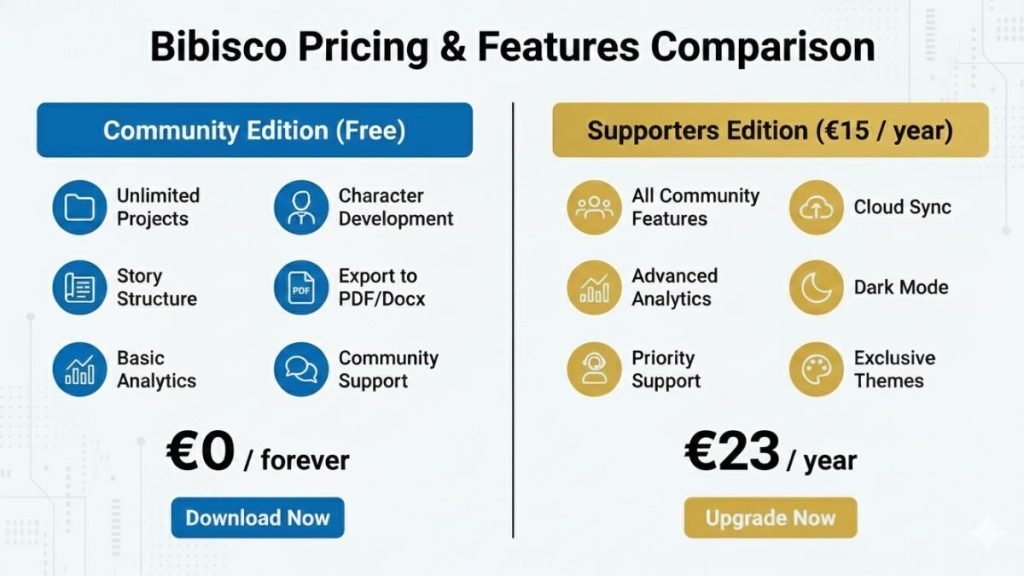
Bibisco uses an interesting “pay-what-you-want” model with two editions:
Community Edition (Free)
Price: €0 (completely free forever)
Includes:
- Full writing environment
- Unlimited projects, chapters, and scenes
- Complete character development tools
- Timeline and analysis features
- Basic export (PDF, DOCX, EPUB)
- Location and object databases
- All core novel-writing features
Limitations:
- No custom themes
- Limited export customization
- No premise and fabula architecture
- No project analysis reports
- Standard text editor only
My Take: The Community Edition is shockingly complete. I wrote my entire 50,000-word test novel using only free features. For 95% of novelists, this version provides everything needed.
Supporters Edition (€23)
Price: €23 one-time payment (~$25 USD)
Additional Features:
- Custom themes (dark mode, color schemes)
- Advanced export options with custom formatting
- Premise architecture – deeper story structure tools
- Fabula – chronological story timeline distinct from narrative order
- Analysis dashboard with writing statistics
- Priority email support
- Support independent development
My Take: The Supporters Edition is excellent value if you want visual customization and advanced structural tools. The dark mode alone is worth €23 for night writers. However, the Community Edition is so complete that upgrading isn’t mandatory.
Is Bibisco Worth the Price?
Free Version: Absolutely yes. You risk nothing trying bibisco, and the free version rivals paid software costing $50-100.
Paid Version: Worth it if you:
- Write multiple novels annually
- Want dark mode for night writing
- Need advanced story structure visualization
- Appreciate supporting open-source developers
Not worth it if: You’re writing your first novel or only write occasionally. Start with the free version and upgrade later if needed.
How Bibisco Pricing Compares to Competitors
- Scrivener: $59.99 (one-time)
- Atticus: $147 (one-time) or $29.99/month
- yWriter: Free
- Manuskript: Free
- Bibisco Community: Free
- Bibisco Supporters: €23 (~$25)
Bibisco offers the best value in novel writing software. Only yWriter and Manuskript compete on price, but both have steeper learning curves and less intuitive interfaces.
Bibisco vs Scrivener: Which Is Better?
This is the comparison every writer asks. I’ve used both extensively, so here’s my detailed breakdown:
Feature Comparison Table
| Feature | Bibisco Free | Bibisco Paid | Scrivener |
|---|---|---|---|
| Price | €0 | €23 | $59.99 |
| Character Development | ✅ Excellent | ✅ Excellent | ⚠️ Basic templates |
| Timeline Tracking | ✅ Automatic | ✅ Automatic | ❌ Manual only |
| Distraction-Free Writing | ✅ Yes | ✅ Yes | ✅ Yes |
| Export Formats | PDF, DOCX, EPUB | PDF, DOCX, EPUB | PDF, DOCX, EPUB, MOBI, Final Draft |
| Research Storage | ❌ No | ❌ No | ✅ Extensive |
| Corkboard View | ❌ No | ❌ No | ✅ Yes |
| Split-Screen Editing | ❌ No | ❌ No | ✅ Yes |
| Mobile Apps | ❌ No | ❌ No | ✅ iOS ($23.99) |
| Compile Options | ⚠️ Basic | ✅ Advanced | ✅✅ Extremely advanced |
| Learning Curve | ✅ Easy | ✅ Easy | ⚠️ Steep |
| Non-Fiction Support | ❌ Novel-only | ❌ Novel-only | ✅ Excellent |
| Screenplay Support | ❌ No | ❌ No | ✅ Yes |
| Cloud Sync | ❌ No | ❌ No | ⚠️ Manual (Dropbox) |
| Operating Systems | Win, Mac, Linux | Win, Mac, Linux | Win, Mac (separate licenses) |
| Updates | ✅ Free forever | ✅ Free forever | ⚠️ Paid major upgrades |
Pricing Comparison
Bibisco:
- Community: Free forever
- Supporters: €23 one-time, all future updates included
Scrivener:
- Desktop: $59.99 (Windows OR Mac, not both)
- iOS: Additional $23.99
- Major version upgrades: ~$25 every 5-7 years
- Total for Windows + Mac + iOS: ~$147
Winner: Bibisco by a landslide for budget-conscious writers.
User Experience & Learning Curve
Bibisco:
- Intuitive interface requiring no tutorial
- Novel-specific workflow feels natural
- Limited features = less overwhelming
- Started writing within 15 minutes of installation
Scrivener:
- Complex interface with 100+ features
- Requires hours of tutorial videos to use effectively
- Powerful but intimidating for beginners
- Takes days/weeks to feel comfortable
Winner: Bibisco for beginners and writers who want to start immediately. Scrivener for power users who invest time learning.
When to Choose Bibisco
Choose bibisco if you:
- Write fiction exclusively (especially novels)
- Need strong character development tools
- Want automatic timeline tracking
- Prefer simplicity over feature overload
- Have a limited budget
- Write on Linux (Scrivener barely supports it)
- Need multi-language interface
When to Choose Scrivener
Choose Scrivener if you:
- Write multiple genres (non-fiction, screenplays, academic)
- Need extensive research organization
- Want split-screen editing for reference materials
- Require mobile writing capabilities
- Need highly customized export formatting
- Work with long-form non-fiction or academic writing
- Want corkboard and outliner views
Final Verdict: Bibisco or Scrivener?
For most novelists, especially beginners: Bibisco wins. The free version handles 95% of novel-writing needs with better character tools and automatic timeline tracking. The simplified interface lets you focus on writing instead of software management.
For professional multi-genre writers: Scrivener wins. The advanced compile options, research organization, and non-fiction support justify the higher price for full-time authors managing diverse projects.
My recommendation: Start with bibisco Community Edition (free). If you outgrow it after finishing your first novel or two, upgrade to Scrivener. Most writers never need to switch.
How to Download and Use Bibisco (Step-by-Step)
Getting started with bibisco takes less than 10 minutes. Here’s my complete guide:
Download & Installation Guide
Step 1: Visit Official Website
- Go to bibisco.com
- Click “Download” in the main navigation
- Select your operating system (Windows, macOS, or Linux)
Step 2: Choose Version
- Community Edition: Click “Download for free”
- Supporters Edition: Click “Buy €23” then download after payment
Step 3: System Requirements
- Windows: Windows 10 or later (64-bit)
- macOS: macOS 10.13 High Sierra or later
- Linux: Ubuntu 18.04+ or equivalent (64-bit)
- RAM: 4GB minimum, 8GB recommended
- Storage: 500MB free space minimum
Step 4: Installation
Windows:
- Open downloaded .exe file
- Follow installation wizard
- Accept default installation location
- Launch bibisco from desktop shortcut
macOS:
- Open downloaded .dmg file
- Drag bibisco icon to Applications folder
- First launch: Right-click → Open (to bypass Gatekeeper)
- Grant necessary permissions when prompted
Linux:
- Extract downloaded .tar.gz file
- Navigate to extracted folder
- Run:
./bibiscofrom terminal - Add to applications menu (optional)
Installation Time: 2-5 minutes depending on internet speed.
Creating Your First Project
Step 1: Launch Bibisco
- Open the application
- First launch displays welcome screen
Step 2: Create New Project
- Click “Create new project”
- Enter project name (e.g., “My First Novel”)
- Choose project language (affects spell-check)
- Select storage location (defaults to Documents/bibisco)
- Click “Create”
Step 3: Set Up Story Architecture
- Premise: Describe your story concept in one sentence (e.g., “A young wizard discovers he’s destined to defeat an ancient evil”)
- Fabula: Optional—outline the chronological story events
- Setting: Define when and where your story takes place
- Click “Save” for each section
Setting Up Characters & Locations
Creating Your First Character:
- Click “Characters” in left sidebar
- Click “+” button (Create new character)
- Fill in character questionnaire:
- Name: Main character’s full name
- Role: Protagonist, antagonist, or secondary
- Personal Info: Age, appearance, occupation
- Upload photo: Click image placeholder to add reference image
- Work through optional sections:
- Personal data (personality traits)
- Physionomy (physical details)
- Behaviors (habits and mannerisms)
- Psychology (motivations, fears, internal conflicts)
- Sociology (relationships, social status)
- Life before story begins (backstory)
- Conflict (what’s at stake)
- Click “Save” after each section
Tip: Don’t feel pressured to complete every section immediately. I filled in basics first, then added depth while writing.
Creating Locations:
- Click “Locations” in sidebar
- Click “+” to create new location
- Enter location name (e.g., “Dragon’s Keep”)
- Add description and significance to story
- Upload reference image or map
- Click “Save”
Creating Objects:
- Click “Objects” in sidebar
- Click “+” to add new object
- Describe object and its story importance
- Add image if relevant
- Save
Writing Your First Chapter
Step 1: Create Chapter
- Click “Chapters” in sidebar
- Click “+” to create new chapter
- Enter chapter title (or use default “Chapter 1”)
- Click “Save”
Step 2: Create Scene
- Click on chapter name to expand
- Click “+” under chapter to add scene
- Name your scene (e.g., “Opening – Hero discovers letter”)
- Select POV character from dropdown
- Click “Save”
Step 3: Write Scene
- Click scene name to open editor
- Start writing in the text editor
- Use basic formatting toolbar if needed:
- Bold, italic, underline
- Bullet lists and numbered lists
- Paragraph alignment
- Word count updates automatically in bottom-left corner
- Press F11 for distraction-free full-screen mode
Writing Tips:
- Auto-save runs every 30 seconds—no manual saving needed
- Use full-screen mode (F11) to eliminate distractions
- Switch between scenes using left sidebar navigation
- Set scene goals using scene notes feature
Tracking Timeline and Analysis
View Timeline:
- Click “Analysis” in left sidebar
- Click “Timeline”
- Review chronological order of all scenes
- Identify gaps or overlaps in story timeframe
Character Analysis:
- Go to Analysis → Characters
- See which characters appear in which scenes
- Identify characters with too little/much screen time
Location Analysis:
- Go to Analysis → Locations
- Track location usage across narrative
- Ensure setting variety and proper pacing
Exporting Your Manuscript
Step 1: Choose Export Format
- Click project name (top-left)
- Select “Export”
- Choose format:
- PDF: For reading or submission
- DOCX: For editing in Word
- EPUB: For ebook distribution
Step 2: Configure Export Settings
PDF Options:
- Page size (A4, US Letter, custom)
- Margins (narrow, moderate, wide)
- Include character profiles: Yes/No
- Include locations: Yes/No
DOCX Options:
- Basic formatting only
- Chapter breaks style
EPUB Options:
- Metadata (title, author)
- Cover image (upload)
- Table of contents (automatic)
Step 3: Export
- Click “Export”
- Choose save location
- Wait for processing (5-30 seconds for 50,000 words)
- Open exported file to verify
My Export Experience: I exported my 50,000-word test novel to all three formats. PDF looked professional immediately. DOCX opened perfectly in Word with all text intact. EPUB needed minor adjustments in Calibre for final ebook formatting, but 90% of the work was done.
Bibisco Pros and Cons
After 30 days of intensive testing, here’s my honest assessment:
Advantages of Bibisco
1. Completely Free Core Version The Community Edition includes every essential novel-writing feature at zero cost. No trial limitations, no watermarks, no forced upgrades. This is genuine free software, not freemium bait-and-switch.
2. Best-in-Class Character Development Bibisco’s character questionnaires are more comprehensive than any competitor. The structured approach forces deep character thinking that improves writing quality.
3. Automatic Timeline Tracking Setting scene dates and times lets bibisco automatically generate a timeline and catch continuity errors. I found three timeline mistakes I wouldn’t have discovered otherwise.
4. Novel-Focused Design Unlike general writing tools trying to serve everyone, bibisco exclusively targets novelists. This specialization creates an intuitive, purpose-built experience.
5. Lightweight and Fast Bibisco runs smoothly even on older computers. My 6-year-old laptop handled 50,000-word projects without lag.
6. Cross-Platform Support Works identically on Windows, Mac, and Linux. Projects transfer seamlessly between operating systems.
7. Offline-First Approach No internet required after installation. Your manuscripts stay on your computer, not cloud servers. Perfect for privacy-conscious writers.
8. Clean Export Formatting PDF and DOCX exports look professional immediately—no manual formatting fixes needed.
9. Multi-Language Interface Over 20 interface languages plus full Unicode writing support makes bibisco accessible globally.
10. Low Learning Curve I started writing productively within 15 minutes of installation. No multi-hour tutorial required like Scrivener.
Disadvantages of Bibisco
1. No Mobile Apps Bibisco is desktop-only. No iOS or Android apps mean no writing on phones or tablets. This is the biggest limitation for writers who want to write anywhere.
2. Limited Collaboration Features No built-in commenting, track changes, or multi-user editing. You must export to Word for editorial collaboration.
3. Basic Text Editor The editor handles essential formatting but lacks advanced typography controls. No custom fonts, styles, or complex formatting.
4. No Research Organization Unlike Scrivener, bibisco doesn’t include research file storage or reference document management. You’ll need separate tools for research.
5. No Cloud Synchronization Projects save locally only. Manual backup via Dropbox or Google Drive required. Easy to lose work if you don’t establish backup habits.
6. Limited Export Formats Only PDF, DOCX, and EPUB. No direct Kindle (MOBI), Final Draft (screenplays), or LaTeX exports. Requires third-party conversion tools for specialized formats.
7. No Split-Screen Editing Can’t view two scenes simultaneously or reference research while writing. Must switch between sections manually.
8. Novel-Only Focus Terrible for non-fiction, screenplays, academic writing, or short stories. Bibisco is exclusively for novel writing.
9. Minimal Reporting Free version lacks writing statistics and productivity analytics. Supporters Edition improves this but still limited compared to Scrivener.
10. Small Development Team Bibisco is maintained by one primary developer. Updates are less frequent than commercial software, and long-term support depends on community funding.
Overall Verdict
Bibisco excels at: Novel writing with strong characters, timeline management, and distraction-free drafting—all at zero cost.
Bibisco fails at: Mobile writing, collaboration, research organization, and non-fiction projects.
Best for: Solo novelists who write on desktop computers and value character depth over feature complexity.
Not for: Writers needing mobile access, real-time collaboration, or multi-genre writing tools.
Bibisco Alternatives: When to Choose Something Else
While bibisco is excellent for many novelists, it’s not perfect for everyone. Here are the best alternatives:
1. Scrivener ($59.99)
Choose Scrivener if:
- You write multiple genres (non-fiction, screenplays, academic)
- You need extensive research organization
- You want mobile writing capabilities (iOS app available)
- You need split-screen editing
- You require highly customized export formatting
Scrivener beats bibisco in: Research management, non-fiction support, mobile apps, advanced compile options.
Bibisco beats Scrivener in: Price, character development tools, timeline tracking, ease of use.
2. Atticus ($147 one-time or $29.99/month)
Choose Atticus if:
- You want both writing and professional book formatting
- You need beautiful theme customization
- You prefer modern, visually appealing interfaces
- You plan to self-publish and want integrated formatting
Atticus beats bibisco in: Professional formatting, visual design, self-publishing tools, theme variety.
Bibisco beats Atticus in: Price (free vs $147), character development depth, offline-first design.
3. yWriter (Free)
Choose yWriter if:
- You need bibisco-like features but want Windows-native software
- You prefer traditional desktop application feel
- You want scene-level outlining with more technical detail
yWriter beats bibisco in: Windows integration, detailed scene breakdowns.
Bibisco beats yWriter in: Modern interface, cross-platform support, ease of use, visual design.
4. Manuskript (Free, Open-Source)
Choose Manuskript if:
- You value open-source software and community development
- You need outliner-style organization
- You want snowflake method writing support
- You prefer highly customizable workflows
Manuskript beats bibisco in: Outliner flexibility, snowflake method, customization options.
Bibisco beats Manuskript in: Interface polish, character development tools, timeline automation.
5. Novlr ($10-15/month)
Choose Novlr if:
- You want cloud-based writing accessible from any device
- You need automatic cloud backup
- You prefer subscription pricing over one-time payment
- You want built-in goal tracking and writing statistics
Novlr beats bibisco in: Cloud sync, mobile accessibility, automatic backup, writing analytics.
Bibisco beats Novlr in: No subscription cost, offline access, data privacy, one-time payment.
6. Google Docs (Free)
Choose Google Docs if:
- You need real-time collaboration with editors
- You want automatic cloud backup
- You prioritize accessibility over specialized features
- You need simple, reliable writing without learning curve
Google Docs beats bibisco in: Collaboration, cloud sync, accessibility, commenting, track changes.
Bibisco beats Google Docs in: Novel-specific tools, character development, timeline tracking, distraction-free environment.
Looking for more free writing software options? Check out our comprehensive guide to free writing software to explore other alternatives that might fit your needs.
Frequently Asked Questions (FAQs)
Is Bibisco really free?
Yes, the bibisco Community Edition is completely free forever with no limitations on projects, characters, or chapters. You can write unlimited novels without paying anything. The Supporters Edition (€23) adds extra features like custom themes and advanced analysis, but the free version is fully functional for novel writing.
Is Bibisco better than Scrivener?
Bibisco is better than Scrivener for novelists who want simplicity, automatic timeline tracking, better character development tools, and free software. Scrivener is better for multi-genre writers who need research organization, mobile apps, non-fiction support, and advanced export customization. For most beginner novelists, bibisco is the better choice. For professional multi-genre writers, Scrivener justifies its higher price.
Does Bibisco work on mobile devices?
No, bibisco is desktop-only software for Windows, macOS, and Linux. There are no iOS or Android apps. If mobile writing is essential, consider alternatives like Novlr, Scrivener (iOS only), or Google Docs.
Can I import and export to Microsoft Word?
Yes, bibisco exports to DOCX format that opens perfectly in Microsoft Word. All text and basic formatting transfers correctly. However, bibisco cannot import existing Word documents—you must copy-paste content manually if migrating from Word to bibisco.
Is bibisco suitable for non-fiction writing?
No, bibisco is designed exclusively for novel writing. The character development, timeline tracking, and narrative structure tools don’t translate well to non-fiction. For non-fiction, use Scrivener, Google Docs, or Atticus instead.
Does bibisco have a mobile app for writing on the go?
No, bibisco does not offer mobile apps for iOS or Android. All writing must be done on desktop computers (Windows, Mac, or Linux). If you need mobile writing capabilities, consider Scrivener (iOS only), Novlr (web-based), or Google Docs.
How do I backup my bibisco projects?
Bibisco saves projects locally on your computer without automatic cloud backup. To backup projects: 1. Locate your project folder (usually in Documents/bibisco). 2. Copy the entire project folder to Dropbox, Google Drive, or external hard drive. 3. Create regular backups (weekly recommended). 4. Consider automated backup software like Backblaze or Carbonite
Can multiple authors collaborate on a bibisco project?
No, bibisco doesn’t support real-time collaboration or multi-user editing. For collaborative writing, export your bibisco project to DOCX and use Microsoft Word or Google Docs with track changes and commenting features.
What’s the difference between Community and Supporters Edition?
Community Edition (Free): Includes all essential novel-writing features—characters, locations, timeline, basic exports, full text editor. Perfect for most writers.
Supporters Edition (€23): Adds custom themes (including dark mode), advanced export formatting, premise architecture tools, fabula (chronological timeline), analysis dashboard, and priority support. Worth it for frequent writers who want visual customization and advanced structure tools.
Does bibisco support spell check in multiple languages?
Yes, bibisco supports spell-checking in all major languages. The spell-check language is determined by your project language setting (selected when creating a new project). You can write in any language with proper spell-check support.
Can I use bibisco for screenwriting?
No, bibisco is exclusively for novel writing and doesn’t support screenplay formatting. For screenwriting, use specialized software like Final Draft, Celtx, or Scrivener (which includes screenplay templates).
How do I upgrade from Community to Supporters Edition?
Visit bibisco.com, purchase the Supporters Edition for €23, download the new version, and install it over your existing bibisco installation. All your existing projects transfer automatically—no manual migration needed.
Final Verdict: Should You Use Bibisco?
After 30 days of intensive testing and writing a 50,000-word novel in bibisco, here’s my final recommendation:
You Should Definitely Use Bibisco If:
- You’re writing your first novel and need guidance
- You want specialized novel-writing tools without spending money
- Character development is central to your writing process
- You struggle with timeline continuity in complex plots
- You write exclusively on desktop computers
- You value simplicity and ease of use over feature complexity
- You need multi-language support (interface or writing)
- You prefer offline tools that respect your privacy
You Should Consider Alternatives If:
- You need mobile writing capabilities
- You write multiple genres (non-fiction, screenplays, academic)
- You require real-time collaboration with editors
- You need extensive research organization within your writing tool
- You want advanced formatting and typography controls
- You prefer cloud-based software with automatic backup
My Personal Recommendation
Start with bibisco Community Edition (free). Download it today from bibisco.com, create a test project, and write your first chapter. You’ll know within an hour whether the novel-focused workflow suits your writing style.
If you love bibisco after your first novel, consider upgrading to the Supporters Edition (€23) for dark mode and advanced features. If you outgrow bibisco’s limitations after two or three novels, invest in Scrivener ($59.99) for advanced capabilities.
For 80% of novelists, bibisco is the perfect writing software. It’s free, focused, and effective. The character development tools alone are worth the download.
Where to Download Bibisco
Official Website: bibisco.com
Community Edition: Free download, no registration required
Supporters Edition: €23 (~$25 USD) one-time payment
System Requirements: Windows 10+, macOS 10.13+, or Linux 64-bit
Download Time: 5 minutes including installation
Don’t let analysis paralysis stop you from writing. Download bibisco’s free Community Edition today and start your novel. The best writing software is the one that gets you writing—and bibisco excels at removing barriers between you and your story.
Interested in exploring other options? Check out our comprehensive guide to free writing software to compare bibisco with other tools that might suit your writing needs.